

President Interview Published in The Chemical Daily
An interview with our President was published in The Chemical Daily on Sep 03, 2026.
In the interview, he shares his perspectives as a newly appointed President, including his management philosophy and vision for the future.
-Original Article (Japanese)
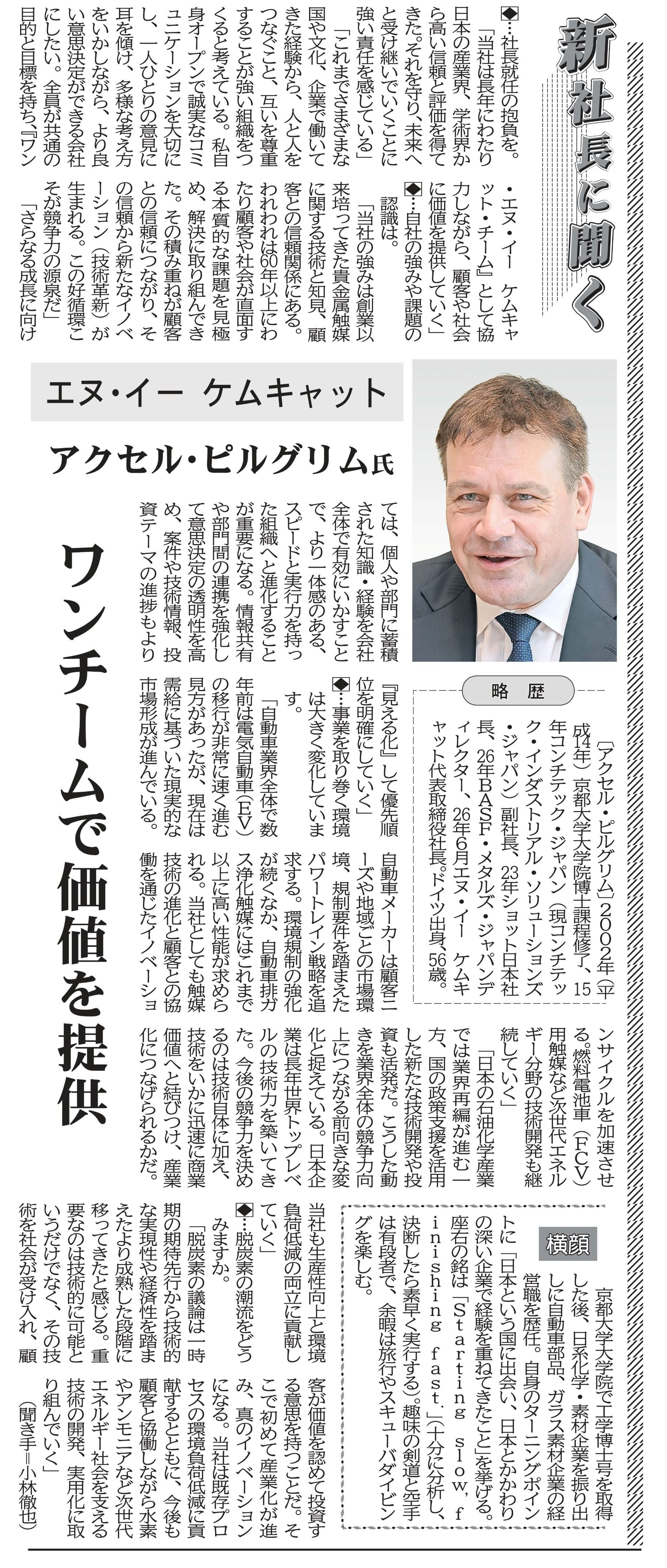
*This article is published with permission from The Chemical Daily. Copyright remains with The Chemical Daily. Unauthorized reproduction, redistribution, forwarding, or republication is prohibited.
-Translation
Interview with the New President Axel Pilgrim, President of N.E. CHEMCAT
◆...Please share your aspirations as you take on the role of president.
"For many years, our company has earned the high trust and esteem of Japan's industrial and academic communities. I feel a strong sense of responsibility to preserve this and pass it on to future generations."
"Based on my experience working in various countries, cultures, and companies, I believe that connecting people and respecting one another builds a strong organization. I personally value open and sincere communication; I want to create a company where we listen to each individual's opinions, leverage diverse perspectives, and make better decisions. With everyone sharing common purposes and goals, we will work together as the 'One N.E. CHEMCAT Team' to deliver value to our customers and society."
◆...How do you view your company's strengths and challenges?
"Our strengths lie in the technology and expertise regarding precious metal catalysts that we have cultivated since our founding, as well as in the relationships of trust we have built with our customers. For over 60 years, we have identified the fundamental challenges faced by our customers and society and worked to solve them. This accumulated effort has led to trust with our customers, and that trust gives rise to new innovations. This virtuous cycle is the very source of our competitiveness."
"To achieve further growth, it is crucial that we evolve into an organization with greater unity, speed, and execution capability by effectively leveraging the knowledge and experience accumulated by individuals and departments across the entire company. We will strengthen information sharing and interdepartmental collaboration to enhance transparency in decision-making, and we will make the progress of projects, technical information, and investment themes more 'visible' to clarify priorities."
◆...The business environment is undergoing significant changes.
"A few years ago, there was a view across the automotive industry that the transition to electric vehicles (EVs) would proceed very rapidly, but currently, a realistic market is taking shape based on supply and demand. Automakers are pursuing powertrain strategies that take into account customer needs, regional market conditions, and regulatory requirements. As environmental regulations continue to tighten, auto exhaust gas purification catalysts are required to deliver higher performance than ever before. We, too, will accelerate the innovation cycle through the evolution of catalyst technology and collaboration with our customers. We will also continue to develop technologies in next-generation energy fields, such as catalysts for fuel cell vehicles (FCVs)."
"While industry consolidation is underway in Japan's petrochemical sector, there is also active development of new technologies and investment leveraging government policy support. We view these trends as positive changes that will enhance the competitiveness of the industry as a whole. Japanese companies have built world-class technological capabilities over many years. What will determine future competitiveness is not only the technology itself but also how quickly we can translate that technology into commercial value and drive industrialization. Our company will also contribute to achieving both improved productivity and reduced environmental impact."
◆...How do you view the trend toward decarbonization?
"I feel that the discussion on decarbonization has moved from a phase dominated by initial expectations to a more mature stage grounded in technical feasibility and economic viability. What is important is not merely that a technology is technically possible, but that society accepts it and that customers recognize its value and are willing to invest in it. Only then can industrialization proceed, and true innovation take place. While contributing to reducing the environmental impact of existing processes, we will continue to work collaboratively with our customers to develop and commercialize technologies that support a next-generation energy society, such as hydrogen and ammonia." (Interviewer: Tetsuya Kobayashi)
Profile
After earning a Doctor of Engineering degree from Kyoto University's Graduate School, he began his career at a Japanese chemical and materials company and went on to hold management positions at automotive parts and glass materials companies. He cites "encountering Japan as a country and gaining experience at companies with deep ties to Japan" as his turning point. His motto is "Starting slow, finishing fast" (meaning to analyze thoroughly, make a decision, and then act quickly). He holds black belts in his hobbies of kendo and karate, and enjoys traveling and scuba diving in his spare time.
Biography
[Axel Pilgrim] Completed his doctoral program at Kyoto University in 2002; served as Vice President of Contitech Japan (now Contitech Industrial Solutions Japan) in 2015; President of Schott Japan in 2023; Director of BASF Metals Japan in 2026; and President and Representative Director of N.E. CHEMCAT in June of 2026. A native of Germany, he is 56 years old.
Note: The English translation is provided for reference purposes only and has been prepared by our company with the permission of The Chemical Daily. The original article was published in Japanese.